Home|International Travel Risk Management: The Most Important Travel Risk Decisions Happen Before Departure


By Iulian Grigore, Head of Physical and Mobility Risk Practice, NSSG
In this article:
Many of the problems encountered during a business trip can be traced back to decisions made before the traveller leaves. A significant number can be reduced through early planning.
Travel risk management is not complicated in principle. It depends on a series of small decisions made early enough to be useful, but those decisions are often compressed or overlooked when travel is arranged at short notice.
This article follows the journey in the order it actually happens: what to settle before accepting the trip, how to manage arrival and local movement, and what to do if conditions change while you are on the ground.
Five things, and none of them take long.
Beyond that, where permitted and appropriate, carry a modest amount of cash in small denominations and keep it in two separate places, and keep your hotel address written in the local language on paper. Phones run out of battery at inconvenient moments.
On many international itineraries, the journey from the airport to the hotel is one of the most exposed parts of the trip, and the reasons are structural rather than circumstantial. Your arrival time is published in advance, the route is fixed and usually the only sensible one, and you arrive tired, carrying everything you brought, in a place you don’t know.
The fix is to arrange the transfer beforehand and verify it. Agree the driver’s name and the vehicle in advance, and confirm both before you get in. Don’t have your name held up on a sign, and never your employer’s name, because a sign announces to everyone in the arrivals hall who you are and who you work for. Agree a recognition phrase instead. If the transfer isn’t there, go back inside and call your contact rather than taking an unbooked taxi at the curb.
Where practical, avoid ground-floor rooms with easy external access and very high floors that may complicate emergency evacuation. More importantly, identify the nearest usable exits and understand the hotel’s emergency procedures before settling in.
What to do: Book and verify the transfer before you fly, and tell someone when you reach the hotel rather than when you land. Where the destination warrants it, arrange secure ground transportation instead of relying on hotel cars or ride-hailing apps.
Journey management comes down to not being predictable and not being alone with a decision. If you’re staying more than a few days, vary your departure times and your routes, because patterns are what get noticed.
Ask the driver to avoid unplanned route changes unless operational conditions require them, and to explain any significant change wherever it is safe to do so.
Know roughly where you sit in relation to three places at all times: your accommodation, the nearest medical facility, and your embassy or consulate. Avoid ground movement after dark where you’ve been advised against it, because in many places the risk profile changes completely at sunset, and the advice usually exists because of specific incidents rather than general caution.
Don’t post your location publicly while you’re still in it. The photographs can wait until you’re home.
What to do: Agree the day’s movements with someone before you set off, and check in when you arrive. A route nobody knows about is a route nobody can help you on.
The risk map is a reference, not a rulebook, and it rewards careful reading rather than a glance. Three patterns on the 2026 edition are worth knowing before you travel.
Four of the ten least safe cities sit in countries that don’t appear on the least safe countries list at all: Dili, Goma, Guatemala City and Port Moresby. If your employer approves travel on a country rating, those four get waved through as routine, and you’ll arrive without the extra briefing the destination actually warrants.
Guyana appears among the worst countries for health and medical care, and among the most difficult to travel in, but not among the least safe. For a destination attracting that much energy-sector travel, the exposure isn’t that something happens to you. It’s what’s available afterwards, and how hard it is to get you out.
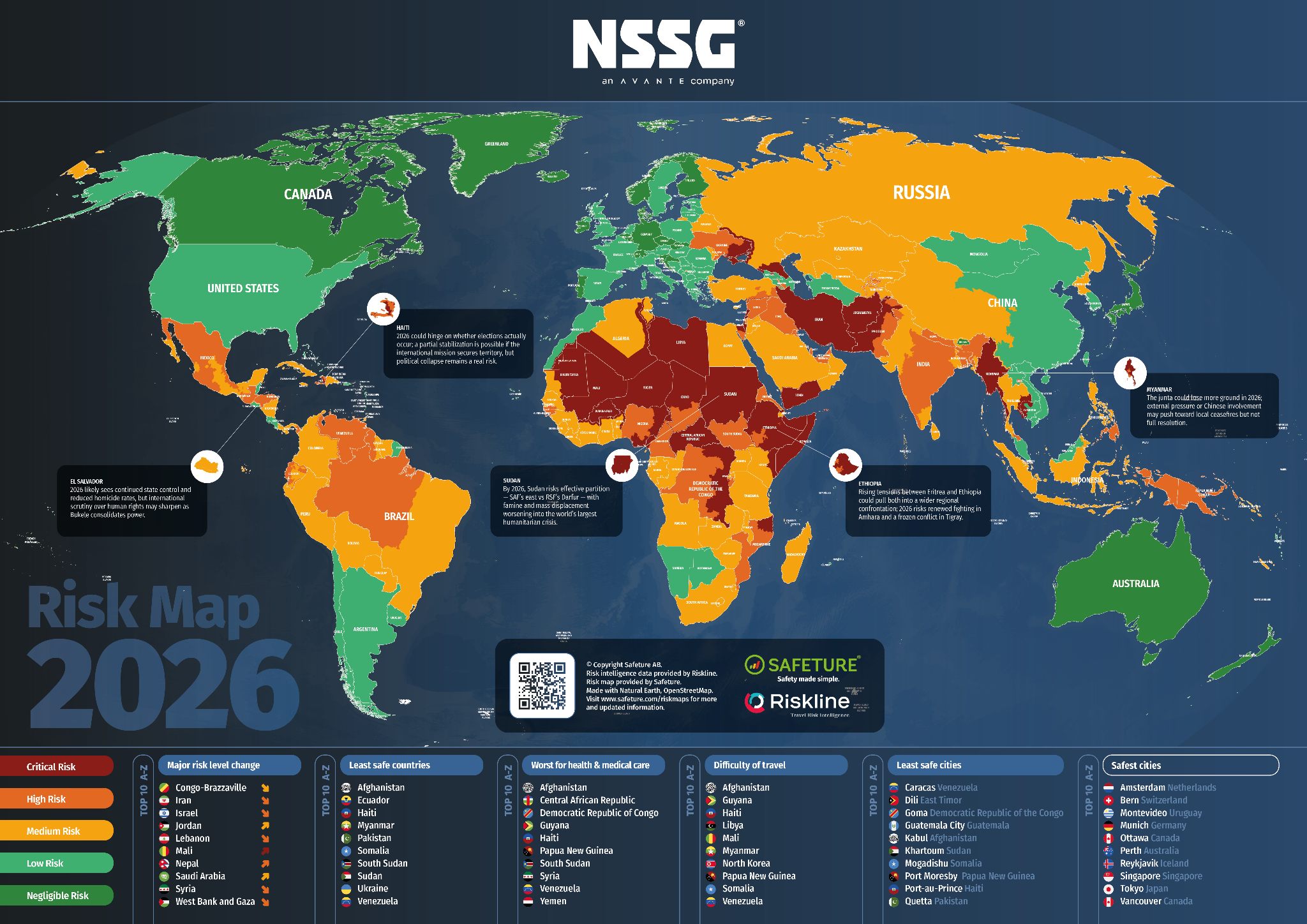
According to Safeture and Riskline, ten destinations show a major risk-level change on the 2026 Risk Map: Congo-Brazzaville, Iran, Israel, Jordan, Lebanon, Mali, Nepal, Saudi Arabia, Syria, and the West Bank and Gaza. Several of those are ordinary business destinations. Ratings are also moving faster than annual policy cycles can absorb: International SOS reported 159 state-based conflicts in 2025, more than in any year since the 1940s.
What to do: Ask for a briefing on the city and the route rather than a country profile. If you get a national overview, it hasn’t answered the question. And if you’re travelling to one of those ten, ask for a current briefing even if you’ve been before.
Report in first. Don’t wait to be contacted, and don’t wait until you’ve worked out whether it’s serious. The people supporting you would much rather hear early about something that turns out to be nothing.
Unless you face an immediate threat or receive official instructions to evacuate, avoid making an uncoordinated move. Contact your support team, assess the situation, and follow verified local or organisational guidance. The instinct when something happens is to move, usually towards the airport, and that instinct is frequently wrong, because roads and transport hubs are where disruption concentrates. Depending on the incident and the safety of the building, temporary shelter in place may be safer than moving through disrupted roads or crowded transport hubs.
Keep your phone charged, your documents on you and some cash accessible. Agree a phrase with your contact beforehand that means you can’t speak freely, and make sure you both remember it.
What to do: Know before you fly who answers the phone at three in the morning and what they can actually do. NSSG’s travel risk management programme runs through a 24/7 C3i operations centre for exactly this reason.
NSSG develops destination briefings around the actual city, route, traveller profile, and timeframe, supported by our 24/7 C3i operations centre. Speak with our travel risk team before departure so that decisions can be made while there is still time to act.
If you’ve got people travelling somewhere the 2026 map flags, talk to our travel risk team before the trip rather than during it.
Your point of contact and whether their number works out of hours, the check-in schedule and what happens if you miss one, whether your insurance covers that specific country, where the nearest capable medical facility is, and who holds your itinerary. These five checks provide a strong foundation, although the destination and traveller profile may require additional measures.
On a typical business itinerary, yes. Your arrival time is known, the route is fixed, and you’re tired and carrying valuables in unfamiliar surroundings. Arranging and verifying the transfer in advance removes most of that exposure at very little cost.
Contact your support line before anything else, then stay put until you’re advised otherwise. Moving towards an airport during a developing situation is a common instinct and frequently the wrong one.