The year 2025 laid the groundwork for the converge of risks that challenged traditional enterprise security risk management frameworks, and this trend will continue in 2026 and beyond. Multinational corporations will face unprecedented confluences of risks, driven by state-sponsored competition, multilateral institutional degradation, economic fragmentation, supply-chain disruption, intensifying technological weaponisation, and climate-change related resource scarcity, leading to further volatility, uncertainty, and complexities in the operating environment. If not today, then tomorrow’s risk leaders should fundamentally evolve in how their respective organisations conceptualise, measure, and manage threats to their assets, services, products and people.
Our Global Risk Outlook 2026 and Beyond examines emerging trends across economic, geopolitical, operational, technological and social domains, mapping these threats to established enterprise risk management frameworks. It is aimed at providing actionable information for those risk leaders representing various business functions across the enterprise.
The core findings are evident: a fundamental change in mindset is necessary to evolve from risk management as a compliance exercise to a critical driver of competitive advantage, organisational resilience, and stakeholder value preservation. Failure to integrate emerging risks into the core organisational strategy will likely expose them to cascading and systemic degradation of financial, operational, reputational, and workforce capital.
This outlook highlights the most consequential emerging risks trends that will shape the environment over the next year and into 2027. It looks at macro-level threats and their respective implications on certain industries such as energy, pharmaceuticals, supply-chain, technology, and critical infrastructure, among others, while aligning analysis to risk management frameworks.
The message is clear: risk management must evolve from a compliance function into a strategic capability.
Download the report by filling in the form below:
Many countries have used citizenship or residency-by-investment programs to attract foreign capital. These programs typically offer passports, residence rights, or other legal and financial advantages in exchange for investments in the local economy. Below is a structured overview of the most common incentives and notable country examples:
How it works: Investors make a non-refundable contribution to a government development fund in exchange for citizenship or permanent residency.
| Country | Incentive | Minimum Contribution | Notable Aspects |
| St. Kitts & Nevis | Donation to the Sustainable Growth Fund | ≈ USD 250,000 | Fast-track citizenship (as little as 4 months), visa-free travel to 150+ countries |
| Antigua & Barbuda | Donation to National Development Fund | ≈ USD 100,000 | Relatively low threshold, family packages |
| Dominica | Donation to Economic Diversification Fund | ≈ USD 100,000 | One of the oldest and cheapest CBI programs |
📝 Rationale: These small island nations rely heavily on foreign investment to fund infrastructure, tourism, and development.
How it works: Foreigners can obtain residency or citizenship by investing in approved real estate projects.
| Country | Incentive | Minimum Investment | Notable Aspects |
| Portugal | Golden Visa program | €280,000–€500,000 | 5-year residency path to citizenship; halted for real estate in 2023 due to housing pressure |
| Greece | Residency permit | €250,000 | Permanent residency with Schengen access |
| Spain | Residency visa | €500,000 | Path to permanent residence and citizenship |
📝 Rationale: Boosts the property market, construction, and related services.
How it works: Applicants receive legal status if they establish or invest in companies, typically with a minimum requirement for job creation.
| Country | Incentive | Requirements | Notable Aspects |
| United States (EB-5 Visa) | Green card | Min. USD 800,000 investment in job-creating projects | Permanent residence after 2 years |
| Canada (Start-Up Visa, Quebec IIP – paused) | Permanent residence | Investment or innovative business + job creation | Focus on entrepreneurship |
| Australia (Significant Investor Visa) | Visa and permanent residence | AUD 5 million investment | Popular with high-net-worth individuals |
📝 Rationale: Stimulates domestic business activity, technology transfer, and employment.
How it works: Investment in state bonds or securities — often refundable after several years.
| Country | Incentive | Investment | Notable Aspects |
| Malta (prior to 2023 changes) | Citizenship by Naturalization for Exceptional Services | €600,000–€750,000 + residence | Included bond or property options |
| Cyprus (until 2020) | Citizenship by investment | €2 million real estate or bonds | Ended after corruption scandals |
| Turkey | Citizenship | $500,000 government bonds | Quick processing, widely used by MENA investors |
📝 Rationale: Provides governments with stable, long-term financing.
How it works: Countries offer attractive tax regimes in combination with residency or citizenship.
| Country | Incentive | Notable Features |
| Monaco | Residency | No personal income tax |
| UAE | Golden Visa (10-year) | Tax-free income, no inheritance tax |
| Malta | Residence or citizenship | Favourable tax regime, EU market access |
| Switzerland (lump-sum taxation) | Residence permit | Attractive for ultra-high-net-worth individuals |
📝 Rationale: Attracts wealthy individuals and their capital, often used in asset protection strategies.
How it works: Residency rights are granted to investors, entrepreneurs, or remote workers with financial means.
| Country | Incentive | Key Features |
| Estonia | e-Residency | Digital business environment (no citizenship) |
| Dubai (UAE) | Remote work visa | Low taxation, access to banking |
| Italy & Spain | Investor / nomad visas | Tax incentives for wealthy individuals |
| Caribbean states | Nomad visas | Encourage relocation of digital professionals |
📝 Rationale: Attracts mobile capital and talent, often linked to tech and service sectors.
Citizenship and residency-by-investment programs are tools to attract capital, stimulate local economies, and increase state revenue. However, they also carry geopolitical, legal, and reputational risks. Modern programs increasingly emphasize transparency, due diligence, and investment in productive sectors rather than just real estate or donations.
Corporate intelligence is no longer just about collecting data — it’s about turning information into impact. We combine human expertise with AI-driven analytics to monitor your competitive landscape, decode market signals, and deliver actionable insights directly to your decision-makers.
With our intelligence frameworks, you’ll not only know what’s happening, but also why it matters and what to do next.
Artificial intelligence and machine learning are redefining how insights are found. Our solutions use predictive and prescriptive analytics to identify risks and opportunities long before your competitors do.
→ Result: Faster, data-driven decisions that anticipate the market, not react to it.
We enable real-time intelligence across markets, media, and regulatory environments.
→ Result: Your leadership team gets the right alert at the right time — before the rest of the industry notices.
We democratize access to intelligence through self-service dashboards and intuitive platforms.
→ Result: Every department — from marketing to R&D — becomes part of your intelligence ecosystem.
We operate under strict governance, ensuring data integrity, security, and compliance with global privacy and ethics standards.
→ Result: Reliable intelligence you can act on with confidence.
We integrate intelligence directly into your existing systems (CRM, ERP, BI platforms).
→ Result: Your teams receive insights in the exact tools they already use — no friction, no delay.
Our analysts work alongside your leadership to align intelligence with corporate goals.
→ Result: Intelligence isn’t just a department — it becomes your organization’s strategic core.
We track not just competitors, but entire ecosystems: technologies, partners, regulators, and geopolitical shifts.
→ Result: A 360-degree view of your environment — so you’re never blindsided.
Sustainability is now a business driver. Our ESG and compliance intelligence helps you anticipate regulations, manage risks, and identify responsible growth opportunities.
→ Result: Future-proof strategies that align with global sustainability goals.
We don’t just build systems — we build intelligence cultures. Through training and advisory, we help your teams think, act, and decide based on evidence.
→ Result: A smarter, faster, more aligned organization.
We leverage global networks, open data, and advanced collection tools to expand your intelligence reach.
→ Result: Broader, deeper insight — without additional overhead.
We don’t just provide intelligence — we operationalize it.
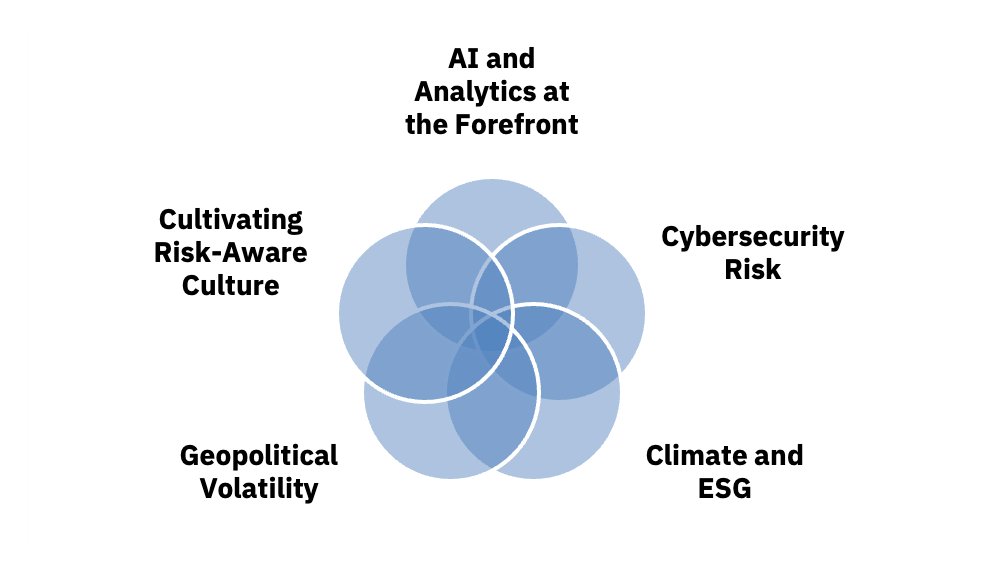
As we advance through 2025, the risk management landscape continues to evolve at an unprecedented pace. For organisations operating in today’s complex global environment, understanding and adapting to these emerging trends isn’t just advantageous, it’s essential for survival and growth. Drawing from our extensive experience by supporting our clients in high-risk operational environments worldwide, NSSG Global highlights the five pivotal trends that are fundamentally reshaping how enterprises approach risk management.
Artificial intelligence and advanced analytics are revolutionising risk management from reactive to predictive. The data are compelling: by 2025, 70% of risk managers will place AI at the center of their strategy. according to Deloitte research, whilst PwC reports a remarkable 35% year-on-year growth in AI adoption within risk management frameworks.
This shift represents more than technological advancement, it’s a fundamental reimagining of how organisations identify, assess, and respond to threats. AI-powered risk intelligence enables companies to spot emerging risks faster, analyse complex data patterns, and predict potential disruptions before they materialise.
The NSSG Perspective: Our experience in complex operational environments has shown that the most effective AI implementations combine sophisticated algorithms with human expertise. Organisations must invest in both technology and talent, ensuring their teams can interpret AI insights within the broader context of their operational reality.
Actionable Framework:
Cyber risks have evolved beyond isolated IT concerns to become integral threats affecting supply chains, vendor relationships, and daily operations. The scale of this challenge is staggering: global cybercrime costs are projected to reach £8.2 trillion annually by 2025, according to Cybersecurity Ventures, whilst the World Economic Forum’s Global Risks Report reveals that 60% of organisations now rank cyber risk as their primary concern.
This interconnectedness means that a cyber incident can cascade through an organisation’s entire ecosystem, affecting partners, suppliers, and customers simultaneously. Traditional perimeter-based security approaches are no longer sufficient in this environment.
The NSSG Approach: Effective cybersecurity risk management requires a holistic view that encompasses not just technology, but people, processes, and partnerships. Our methodology emphasises building resilience across the entire value chain, not just within organisational boundaries.
Strategic Considerations:
Environmental, Social, and Governance (ESG) factors have transitioned from regulatory compliance issues to core business risks that directly impact operational continuity and financial performance. A striking 90% of executives believe climate risk will directly impact their business within the next five years, according to EY research, whilst ESG-related investments have surpassed £27.3 trillion globally in 2024, as reported by Bloomberg.
Climate risks now influence everything from supply chain stability to regulatory compliance, insurance costs, and stakeholder expectations. Organisations must integrate climate and ESG considerations into their fundamental risk management frameworks.
NSSG’s Integrated Methodology: Our approach treats ESG risks as operational realities rather than abstract concepts. We help organisations identify specific climate-related threats to their operations, develop adaptation strategies, and create measurable resilience indicators.
Implementation Strategy:
Geopolitical instability has become a persistent feature of the global business environment, demanding sophisticated resilience planning. KPMG research indicates that 72% of CEOs expect geopolitical instability to disrupt their supply chains in 2025, whilst the World Bank reports a 45% increase in global trade disruptions over the past three years.
These disruptions extend beyond traditional conflict zones, affecting global supply chains, regulatory environments, and market access. Organisations must develop capabilities to navigate this complexity whilst maintaining operational effectiveness.
NSSG’s Global Expertise: Our two decades of experience operating in complex geopolitical environments provides unique insights into building organisational resilience. We understand that effective geopolitical risk management requires both strategic foresight and tactical adaptability.
Resilience Framework:
The most critical trend is the recognition that effective risk management depends fundamentally on organisational culture. Companies with strong risk cultures are 2.5 times more resilient during crises, according to McKinsey research. However, a concerning 65% of employees report lacking adequate training to identify risks, as revealed by Protiviti’s survey.
Building a risk-aware culture requires more than policies and procedures—it demands embedding risk consciousness into decision-making processes at every organisational level.
NSSG’s Cultural Transformation Approach: We’ve observed that the most resilient organisations treat risk awareness as a core competency, not a compliance requirement. This involves creating environments where employees feel empowered to identify and report potential risks without fear of blame.
Culture Development Strategy:
As we’ve examined these five trends, a clear pattern emerges: risk management in 2025 needs to become “proactive, digital, and human-centred.” The organisations that will thrive are those that embrace this evolution, combining advanced technology with human insight and organisational culture.
The convergence of these trends creates both challenges and opportunities. Whilst the risk landscape becomes more complex, the tools and methodologies for managing these risks are becoming more sophisticated and effective. Organizations which will embed a risk management culture will be better equipped to exploit opportunities.
For organisations seeking to enhance their risk management capabilities:
The risk management landscape of 2025 demands a new level of sophistication, integration, and agility. Organisations that recognise and adapt to these trends will not only survive but gain significant competitive advantages in an increasingly uncertain world.
NSSG Global has been helping organisations navigate complex risk environments for over two decades. Our expertise in AI-powered risk intelligence, geopolitical analysis, and crisis management enables clients to transform challenges into competitive advantages. To learn more about how these trends might affect your organisation, contact our risk management specialists for a confidential consultation.
Proactive journey management and secure transportation solutions are essential for safeguarding your organization’s most valuable assets—its people, including corporate executives, C-suite executives, high net worth individuals, and other high-profile individuals. Executive travel exposes business travel to unique risks that require specialized attention.
Here are key safety tips for executives on the move, drawing on the industry’s best practices in protective mobility and travel risk management, and highlighting the need for comprehensive security strategies for these types of travelers:
Executive travel exposes business leaders and high-profile individuals to a unique set of risks that go far beyond those faced by typical travelers. From physical threats like kidnapping, assault, and theft to digital dangers such as cyberattacks and data breaches, the stakes are high for both personal safety and the protection of sensitive company information. Executives may also encounter natural disasters, health concerns, and sudden shifts in the political climate, all of which can disrupt travel plans and compromise security.
To protect executives and ensure their focus remains on business objectives, companies must implement enhanced security measures. This starts with comprehensive pre-travel risk assessments and security assessments to identify potential threats and high-risk areas. Contingency planning is essential, allowing for rapid response to emergencies and minimizing the impact of unforeseen events. By taking a proactive approach to travel security, organizations can safeguard their business leaders, maintain operational continuity, and provide peace of mind for all involved.
Before any departure:
Pro Tip: Partner with a global security provider like NSSG for tailored destination risk analysis.
Awareness is a cornerstone of executive travel security. Business leaders and high-profile individuals must be attuned to the local environment, including the political climate, local authorities, and cultural practices that may affect their safety. Conducting thorough pre-trip intelligence and risk assessments helps identify high-risk areas and potential risks, enabling executives to make informed decisions about where to travel and how to behave.
Maintaining discretion is equally important, and executives should avoid publicizing travel plans and remain vigilant about their surroundings. Utilizing secure transportation and adhering to local customs can further reduce the risk level. Digital security is also vital; using multi-factor authentication and being cautious with public Wi-Fi can help protect sensitive information. By staying informed and adopting a proactive approach, executives can significantly enhance their travel security and ensure a safer journey.
Executive exposure often peaks during ground movements, making ensuring safety a top priority. To mitigate this:
A robust journey management plan (JMP) includes close protection teams as part of the security detail, ensuring immediate and ongoing security coverage for executives throughout their travel:
Best Practice: Integrate GPS-enabled apps with a 24/7 Operations Center for continuous oversight.
Executives should avoid:
NSSG advises practicing a “need-to-know” approach to trip details, even within your organization.
In today’s connected world, digital protection is a critical aspect of executive travel security. Executives are prime targets for cyber threats, making it essential to safeguard devices and sensitive information. Best practices include using secure, encrypted communication channels for emails and messaging, and always enabling multi-factor authentication on all accounts. Keeping devices and software updated helps close security gaps that hackers might exploit.
Executives should also be mindful of their digital footprint—limiting social media activity and avoiding the sharing of sensitive information online can prevent valuable data from falling into the wrong hands. When using public Wi-Fi, it’s important to connect through a trusted VPN to maintain privacy and security. By prioritizing digital protection, executives can reduce their exposure to cyber risks and ensure their information remains secure throughout their travels.
Continuous, real-time monitoring is essential for executive travel security, especially in a rapidly changing global landscape. A dedicated global security operations center (GSOC) provides 24/7 oversight, tracking the executive’s location, monitoring local news and events, and identifying potential threats as they arise. This level of vigilance allows security teams to respond at a moment’s notice, coordinating with local authorities and providing immediate support in case of emergencies.
With continuous monitoring, companies can anticipate and mitigate risks before they escalate, ensuring executives are protected wherever they go. The GSOC also serves as a central hub for communication, keeping executives and their teams informed and connected. This comprehensive approach to travel security delivers peace of mind, allowing executives to focus on their business objectives while knowing their safety is in expert hands.
Ensure:
NSSG clients benefit from pre-travel briefings and embedded response capabilities.
The final steps before departure are crucial for ensuring executive travel security. Security teams should conduct a last-minute risk assessment, review the executive’s itinerary, and confirm all security arrangements are in place. Briefings on potential threats, emergency procedures, and communication protocols help prepare the executive for any scenario.
It’s also important to verify that all necessary documents, equipment, and contact information are readily available. These final preparations provide comprehensive protection and peace of mind, allowing executives to concentrate on their business objectives without distraction. By taking these proactive measures, companies can ensure their leaders are fully protected and ready to travel safely and securely.
Outsourcing travel risk management to experts ensures:
At NSSG, our global network supports executives from departure to destination with seamless protection.
Executive travel doesn’t have to be high-risk. With the right protocols, intelligence, and professional support, organizations can empower their leaders to operate globally—safely and effectively. NSSG can provide services such as executive protection, secure transportation, and risk management to ensure your team arrives safe, ready, and resilient.