Home|Between War and Deal – Seeking Stability in Instability


By Nima Khorrami – NSSG Intelligence Analyst
The past two weeks have sharpened a contradiction that now defines the conflict: both the United States and Iran are simultaneously exchanging diplomatic proposals via Pakistan and preparing for renewed war. Trump’s much anticipated Beijing summit with Xi produced no Chinese commitment to pressure Tehran — at least not publicly — while Iran’s Foreign Minister used his appearance at the BRICS summit in New Delhi to dampen hopes for a nuclear deal before and/or in parallel with a peace agreement.
Back in Washington, multiple reports pointed to active US-Israeli planning for strikes on Kharg Island and commando raids aimed at seizing Iran’s highly enriched uranium stockpile. However, the pendulum of public diplomacy swung back in a more positive direction on May 22, as officials on both sides once again spoke of increased prospect of reaching an agreement. Overall, there appears to be a growing consensus on the ground that the foundations of a limited deal are indeed taking shape but a sustainable long term agreement remains a distant prospect, and that the possibility of a surprise US, or US backed, strike remains unlikely to meaningfully diminish in the interim.
The structural story of this fortnight is Iran’s systematic effort to convert wartime facts on the ground into durable institutional arrangements. The Hormuz Safe insurance platform and the vessel declaration regime are likely to be the architecture of a new maritime order which is being assembled incrementally under cover of a ceasefire that neither side is fully observing. Tehran’s calculus is that the longer these arrangements persist, the harder they become to reverse regardless of what any eventual deal says.
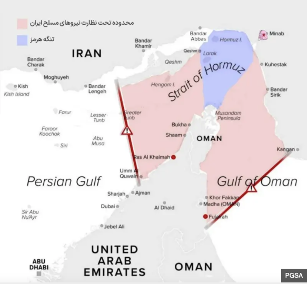
China’s posture at the Beijing summit, meanwhile, confirmed its strategic patience. Although expert opinion differs on this, it is reasonable to assume that Beijing has little incentive to break the stalemate in the short term. The current situation
Beijing ultimately wants an agreement and is contributing to such an outcome both directly and indirectly via Pakistan, but it is in no hurry; it can weather the short-term crisis better than any of its peers while pocketing some easy geopolitical wins.
Inside Iran, the continuing internet blackout is beginning to crack under its own contradictions. A Presidential survey found 70% opposition to restrictions. Moreover, four days of demonstrations at the Petronad Petrochemical as well as students protest across multiple cities in Lorestan Province are the first reported labour action and student-led protests since the war began. These episodes are not yet destabilising but they are a reminder that the war has most probably bought the regime time not a reprieve from its deeper structural problems, and that the regime, in its current form, could still collapse under the weight of its own unpopularity and mismanagement.
For Gulf-based commercial actors, the headline risk remains the strait but the sub-surface risks are multiplying faster. Qatar, Kuwait, and Bahrain have no pipeline bypass options and are the most exposed to prolonged disruption. Moreover, Bahrain’s return to citizenship-stripping as a tool of political control could surface domestic tensions that complicate the operating environment and, in the worst case scenario, necessitate the involvement of other GCC states to ensure stability in Manama. In this context, the deployment of 8,000 Pakistani troops to Saudi Arabia can also be interpreted as part of a broader force-posture calculation: by reinforcing the Kingdom’s domestic security baseline, Riyadh would retain the capacity to project or deploy Saudi forces elsewhere in the region without significantly weakening security at home.
Lastly, the drone attacks on the Barakah nuclear plant launched from Iraq introduce a less-discussed but pivotal dimension to the UAE’s vulnerability landscape: critical targets can be hit from multiple locations outside Iran. At the same time, revelations of ties between the UAE and Israel that run deeper than initially acknowledged could heighten the threat of lone-wolf attacks carried out by or on behalf of Iran or Islamist extremist groups.